LARGECAP Token-4 is Published-CryptoEdy 2027 Crypto Outlook: Identifying Large-Cap Tokens Before the Next Rally | CryptoEdy
PROLargeCap Altcoins
LARGECAP Token-4 is Published-CryptoEdy 2027 Crypto Outlook: Identifying Large-Cap Tokens Before the Next Rally
CE
Lead Analyst
Jul 25, 202617 min read
LARGECAP Token-4 is Published-CryptoEdy 2027 - Institutional Money and the Next Crypto Rally: Large-Cap Tokens to Watch Before March 2027
FOURTH Large cap Token is Published Date-25 July 2026 - The Layer-1 Blockchain Powering a Secure Web3 Ecosystem-Token-4x-6x-Multifold Returns for Crypto Bull Run: CryptoEdy Research: Positioning for the Next Crypto Market Rally
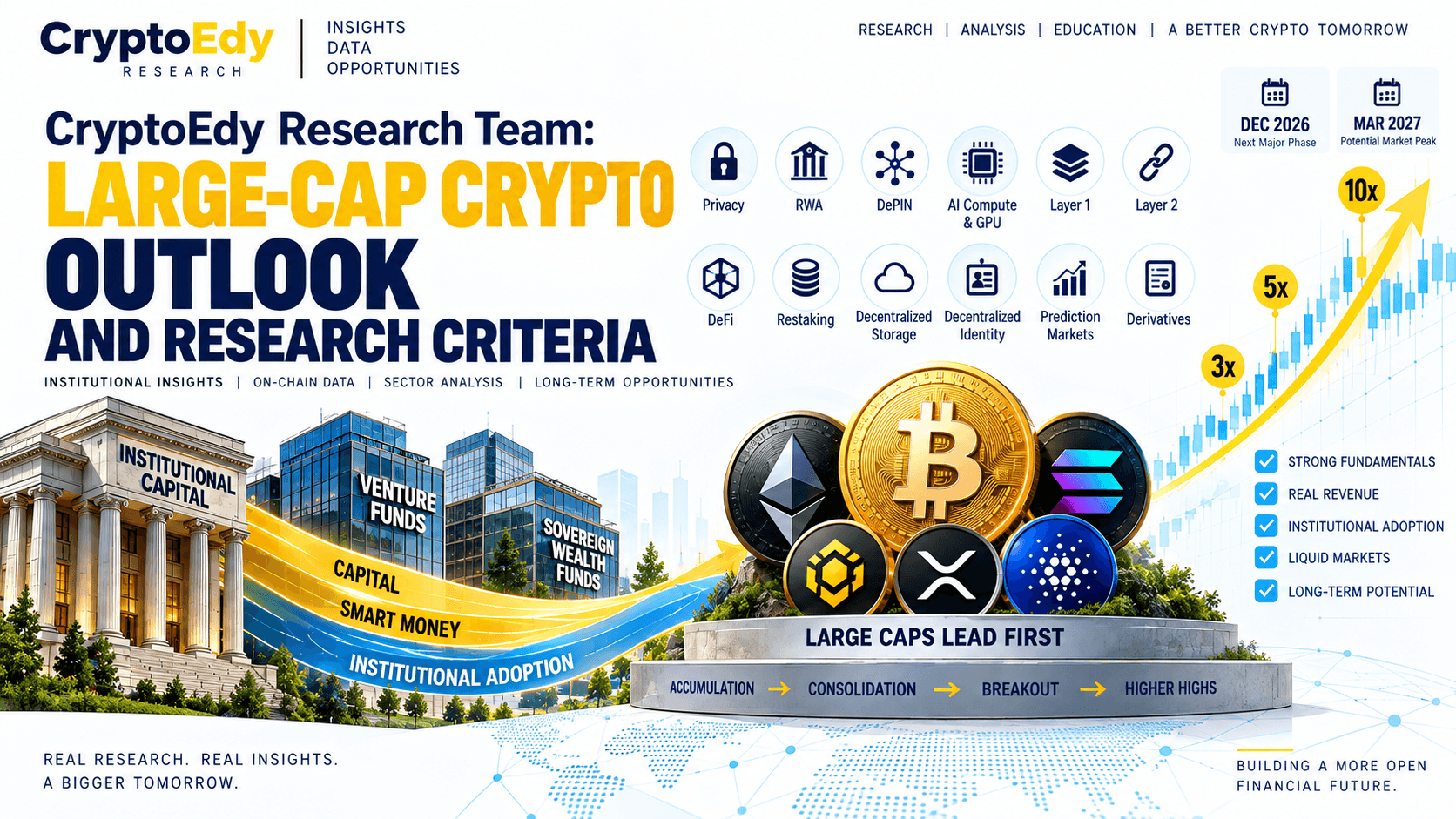
At CryptoEdy Research, our research framework anticipates the possibility of a broader crypto market rally before March 2027, with large-cap cryptocurrencies potentially leading the next major market expansion.
Historically, liquidity tends to move through the crypto market in stages. During the early phase of a major market cycle, institutional and sophisticated capital often focuses on large-cap assets with deeper liquidity, established ecosystems, stronger infrastructure, and greater market participation before expanding into smaller-cap and higher-risk segments.
Our focus is therefore not simply on hype-driven tokens. We are looking for fundamentally driven crypto projects with active development teams, real-world applications, growing protocol activity, and sustainable sources of ecosystem or protocol revenue.
Our Large-Cap Crypto Research Framework:
CryptoEdy Research will publish detailed research reports on selected large-cap crypto assets, explaining why institutional and smart-money liquidity could potentially flow into these projects and what fundamental or structural catalysts could support their adoption.
Our research framework evaluates multiple factors, including:
Liquidity and market depth
Exchange availability and listings
Circulating supply and token distribution
Number and growth of token holders
On-chain activity
Staking participation
Protocol revenue and economic activity
Developer activity and ecosystem growth
Token utility and value accrual
Institutional adoption
Market structure and liquidity positioning
Current consolidation and accumulation phases
Potential catalysts and upcoming developments
Key Crypto Categories Under Our Research Coverage:
A key objective of our research is to identify projects that are currently in consolidation or accumulation phases but possess characteristics that could support stronger performance during a broader market expansion.
We particularly focus on assets with relatively broad holder distributions, meaningful circulating supply, established on-chain ecosystems, staking participation, and demonstrable protocol activity.
Our objective is not simply to identify tokens that could rise with the overall market. We aim to understand why a particular asset could attract liquidity, what catalysts could drive demand, and whether its underlying ecosystem provides a fundamental basis for continued growth.
Searching for 3X, 5X ,10x and Potentially Higher Opportunities:
During a strong crypto bull market, selected large- and mid-cap assets can potentially generate significant returns as liquidity rotates across market sectors.
Our research will therefore identify projects that, based on their fundamentals, liquidity structure, market positioning, adoption, and catalysts, could have the potential for 3X, 5X, 10x or even higher returns during a strong bull-market cycle.
Some individual assets may also experience substantial moves of 300%–500% or more if market conditions, liquidity, fundamentals, and catalysts align. However, these are potential scenarios rather than guaranteed outcomes, and crypto assets remain highly volatile and speculative.
The December Liquidity Pattern:
Our historical market research has also identified a recurring pattern in which large-cap crypto assets have sometimes experienced notable rallies toward the end of the year, including the period leading into December and year-end.
While historical patterns do not guarantee future performance, these seasonal and liquidity-related tendencies can provide another data point when combined with market structure, macroeconomic conditions, institutional flows, on-chain activity, and fundamental analysis.
CryptoEdy Research: Hand-Picked Large-Cap Tokens:
Our research team is continuously screening the crypto market to identify high-conviction research candidates based on measurable fundamentals rather than short-term hype.
We will publish selected large-cap crypto assets together with the underlying research thesis, including: Why the project matters → Why liquidity could enter → What catalysts could drive demand → Where the token currently sits in its market cycle → What risks could invalidate the thesis.
Our goal at CryptoEdy Research is to bring investors and crypto market participants a disciplined, research-driven framework for navigating the next potential market cycle.
We are not chasing every token. We are searching for the projects with the strongest combination of fundamentals, liquidity, adoption, technology, and market structure.
Unlock The Full Access of the FOURTH Large Cap Token Here:
Gate Token of GateChain- Ticker- GT Consolidation Zone: 1 Feb2026 to 25 July2026 Potential Upward Breakout Could Signal the Start of a Bull Run. GATE -TICKER- GT Buying Zone-$6.60-$7.26 Target 1- $9.25 Targets2 -$13.35 Targets 3- $18.45 Targets 4- $25.00 Bull Run Target-$35-$45-(6x-7x Returns) STOP LOSS- $6.00
Gate Chain- GT Token Summary:
GateToken (GT) is the native utility asset connecting two sides of the Gate ecosystem: the centralized Gate trading platform and Gate's blockchain infrastructure, principally GateChain and Gate Layer.
GT was launched in 2019 and became Gate's official platform token in 2020. Gate's own documentation describes GT as serving exchange-related functions such as trading-fee benefits and ecosystem privileges, while also functioning as the native asset used for gas and Proof-of-Stake security on GateChain.
This makes GT structurally different from a pure centralized-exchange loyalty token. Its economic exposure comes from:
Gate's centralized exchange activity
GateChain
Gate Layer
Gate Wallet/DEX infrastructure
Staking and validator/delegation activity
GT-based ecosystem privileges
A continuing burn mechanism
Emerging AI-agent infrastructure through Gate for AI
Gate Layer, launched on an OP Stack architecture with GateChain as the settlement layer, was positioned as a high-performance EVM-compatible Layer 2. Gate stated that the network could reach more than 5,700 transactions per second and use GT as an important part of the ecosystem's security/economic architecture.
The most important distinction for investors is that GT is not itself a decentralized AI token. Gate's AI exposure became more relevant in March–April 2026 when Gate introduced Gate for AI, a unified interface allowing AI agents to interact with centralized and on-chain trading functions. GT holders were given specific ecosystem benefits.
Why GT attracted attention :
Five structural factors were particularly relevant:
A large and established centralized exchange ecosystem behind the token.
Expansion from exchange services into Layer 2/Web3 infrastructure.
A long-running burn mechanism that had removed approximately 189.95 million GT by the 6 July 2026 Q2 burn.
Direct token utility through trading-fee discounts, VIP privileges, Launchpad/Launchpool/HODLer-related programs, gas, staking and delegation.
Expansion into AI-agent infrastructure and broader multi-asset financial services.
The Q2 2026 burn alone removed 2,570,063.38 GT, valued at more than $17.75 million, bringing cumulative burned GT to approximately 189.95 million, according to Gate's 6 July announcement.
At the 20 July 2026 market- GT closing around $6.70, with approximately $715.8 million in market capitalization.
GateChain:
GateChain is the public blockchain component of the ecosystem.
GT serves as:
native gas asset
staking asset
validator/delegation asset
network incentive asset
asset-management utility
Gate's documentation also describes GateChain as an EVM-compatible blockchain with features aimed at digital-asset security and asset recovery.
Gate Layer represents the more significant infrastructure expansion.
It is built using the OP Stack, is EVM compatible, and uses GateChain as its settlement layer. Gate reported approximately 5,700+ TPS capacity and approximately one-second block production.
Gate's June 2026 transparency report subsequently reported more than 43.8 million Gate Layer transactions during June, up more than 9% from May.
Why Gate Layer matters to GT:
A successful Layer 2 can create multiple GT demand channels:
gas
staking/security
ecosystem applications
DEX activity
liquidity
wallets
developer activity
cross-chain transfers
However, transaction count alone does not prove economically meaningful GT value capture.
Gate for AI:
Gate's AI strategy is materially different from decentralized GPU networks such as Akash or decentralized AI-compute protocols.
Gate for AI was designed as an AI-agent interface to trading and on-chain infrastructure.
Gate stated that AI agents could access:
CEX trading
on-chain trading
wallets and signing
market information
on-chain data
Therefore: GT = exchange/Web3 ecosystem token with AI exposure
rather than: GT = decentralized AI-compute token
This distinction is important when comparing GT with AI-focused crypto projects.
GT - AI + Crypto Market Opportunity:
GT's AI thesis should be understood through Gate's ecosystem, rather than by treating GT as an AI-compute token.
Four relevant layers:
1. AI agents
AI agents increasingly require the ability to:
obtain market data,
analyze information,
execute transactions,
manage wallets,
interact with smart contracts.
Gate for AI was explicitly designed around this use case.
2. Crypto-native AI applications
AI agents can potentially interact with:
DEXs
perpetual markets
lending protocols
wallets
cross-chain infrastructure
token markets.
Gate's unified AI interface was designed to expose both centralized and on-chain functions.
3. AI infrastructure
Gate's later 2026 ecosystem reporting described Gate.AI as supporting more than 200 models and enterprise-oriented model routing/API infrastructure.
This is ecosystem-level AI infrastructure rather than a decentralized GPU network.
4. GT's potential role
GT can benefit indirectly if AI-driven activity increases:
trading volume,
Gate DEX activity,
Gate Layer transactions,
wallet usage,
ecosystem participation,
demand for GT-related privileges.
This is an indirect demand thesis, not a direct AI-compute token thesis.
Five Fundamental Reasons GT Could Have Multifold Upside Potential
Reason 1 — Gate is attempting to turn GT from an exchange token into a broader ecosystem asset:
Historically, exchange tokens were primarily associated with:
fee discounts,
VIP levels,
launchpad access.
GT now has additional exposure to:
GateChain,
Gate Layer,
staking,
DEX infrastructure,
wallets,
AI-agent infrastructure,
broader financial products.
Gate Layer's architecture and June transaction growth demonstrate that the ecosystem is moving beyond a single exchange product.
Demand mechanism
More ecosystem activity could create more situations in which users need, hold or interact with GT.
Risk:
Greater product breadth does not automatically equal greater GT value capture.
Reason 2 — The burn mechanism creates a measurable scarcity component:
Approximately 189.95 million GT had been burned by 6 July 2026. [S4]
H1 2026 alone accounted for more than 5.1 million GT of reported burns.
Demand mechanism :
If GT demand grows while the economically available supply continues to contract, the supply-demand balance could become increasingly supportive.
Bull-market amplification
During a strong crypto cycle:
exchange volumes can rise,
trading activity can rise,
new users can enter,
ecosystem participation can increase,
token demand can increase.
If burn activity remains connected to platform activity, the scarcity mechanism could become more visible.
Risk
A burn does not necessarily create proportional price appreciation. Supply classification and new issuance must be monitored.
Reason 3 — GT combines centralized-exchange utility with public-chain utility:
GT is unusual because it has two principal economic environments:
CeFi
trading
VIP
fee benefits
Launchpad/Launchpool
ecosystem incentives
On-chain
gas
staking
delegation
GateChain
Gate Layer.
Why this matters
A user who begins on the centralized exchange can potentially move into:
The centralized-exchange side remains economically dominant. If Gate's exchange activity weakens, GT could be affected even if the blockchain continues operating.
Reason 4 — GT has emerging exposure to AI-agent commerce
Gate for AI represents one of the more interesting developments because it connects AI agents to financial infrastructure.
AI agents potentially need:
information,
execution,
wallets,
transaction signing,
on-chain data,
trading APIs.
Gate's AI interface was explicitly designed around these functions.
Potential GT demand pathway:
AI adoption → more automated trading/on-chain activity → more Gate ecosystem usage → potentially greater demand for Gate services and GT-linked privileges.
Risk
The AI-agent market is competitive, and Gate for AI must demonstrate sustained user and transaction adoption rather than merely technological availability.
Reason 5 — GT's market capitalization leaves room for ecosystem-driven repricing if adoption expands
On 20 July 2026, GT's market capitalization was approximately $716 million.
For a token connected to an exchange, Layer 2, wallet, DEX, staking and AI-agent ecosystem, this creates a mathematically meaningful asymmetry if the underlying ecosystem were to expand substantially.
This does not mean GT must reach any particular valuation.
It means that relatively moderate changes in market capitalization can produce substantial percentage changes from a sub-$1 billion starting base.
What Must Happen for the Bull Case to Work?
The strongest measurable confirmation signals would be:
1. Gate Layer growth
Monitor:
monthly transactions
active users
TVL
DEX volume
stablecoin supply
developer deployments.
The June 2026 figure of more than 43.8 million transactions provides a useful baseline.
2. Sustained GT burn
Track quarterly:
GT burned
burn value
burn-to-emission ratio
change in economically tradable supply.
3. Increasing GT staking
Higher staking/delegation participation could indicate stronger network utility.
4. Growing exchange activity
Monitor:
spot volume
derivatives volume
institutional volume
market share
active users.
5. AI-agent adoption
The key evidence would be:
number of AI agents using Gate APIs
transaction volume generated by agents
API activity
Gate for AI users
AI-related trading volume.
6. More GT-specific value capture
The strongest development would be increasing GT utility that directly requires users to acquire or retain GT.
What Could Invalidate ?
The thesis would weaken materially if several of the following occurred:
Ecosystem activity grows but does not create meaningful GT demand.
Gate's centralized business experiences a major security or solvency event.
Why GT could be interesting:
The strongest documented fundamental characteristics :
Dual ecosystem exposure — GT connects Gate's centralized exchange ecosystem with GateChain and Gate Layer.
Actual token utility — GT has documented uses involving fees, VIP privileges, ecosystem access, gas, staking and delegation.
Large cumulative burn — approximately 189.95 million GT had been burned by 6 July 2026.
Infrastructure expansion — Gate Layer processed more than 43.8 million transactions during June 2026.
AI-agent optionality — Gate for AI created an emerging link between GT holders and AI-agent financial infrastructure.
The most important conceptual point is that GT is not fundamentally a decentralized AI token. Its AI upside is an additional ecosystem option created by Gate's AI-agent infrastructure.
If those components strengthen simultaneously during a future crypto bull market, the combination could create conditions for significant upside from the sub-$1 billion market-cap base observed around the July 2026 cutoff.
That is a conditional fundamental framework—not a guaranteed return outcome.
Major GT News & Headlines: 6 January 2026 — Gate Wallet infrastructure upgrade
Gate reported a wallet upgrade while GT traded around $10.63. The development formed part of the broader migration toward Gate's Web3 infrastructure and Layer 2 ecosystem. [S6]
Why it mattered: Greater wallet integration potentially increases the number of points at which users interact with Gate's on-chain infrastructure and, indirectly, GT. 8 January 2026 — Q4 2025 GT burn completed
Gate reported a Q4 2025 on-chain burn of approximately 2.164 million GT. Cumulative burned GT reached approximately 184.82 million at that time.
Why it mattered: The event demonstrated that the burn mechanism remained operational entering 2026 and established a baseline for subsequent Q1 and Q2 burns.
Gate announced a major cross-chain architecture update intended to replace historical centralized/opaque cross-chain processes with an on-chain lock-and-release model with auditable transactions. Why it mattered: The change was relevant to GT because GateChain is one of the principal blockchain environments in which GT functions as a native asset.
27 January 2026 — Gate Gas Station launches
Gate Wallet introduced Gas Station, designed to simplify multi-chain gas management. The feature automatically advances network fees when the user's native gas balance is insufficient. [S9]
Why it mattered: Although Gas Station is not itself a GT tokenomics mechanism, it illustrates Gate's strategy of reducing friction between centralized users and on-chain infrastructure.
25 March 2026 — Gate publishes detailed GT tokenomics/utility framework
Gate described GT as a utility token connecting centralized services with GateChain infrastructure. It documented trading-fee benefits, Launchpad/Launchpool/HODLer programs, gas, staking, delegation and ecosystem incentives.
Why it mattered: This was important because GT's fundamental thesis depends on actual usage rather than scarcity alone.
28 March 2026 — Gate Layer and GT ecosystem upgrade
Gate published extensive material around Gate Layer, an EVM-compatible Layer 2 based on the OP Stack, with GateChain as settlement infrastructure and GT integrated into the economic/security model. Gate reported:
EVM compatibility
approximately 1-second block times
theoretical/claimed throughput above 5,700 TPS
low transaction costs
cross-chain capabilities
GT staking/security integration
Why it mattered: This expanded GT's potential addressable utility from an exchange token into a broader blockchain ecosystem asset.
March–April 2026 — Gate for AI launches
Gate stated that it launched Gate for AI in March 2026 as an infrastructure/interface layer designed for AI agents. The system packaged centralized and on-chain trading functions into protocols accessible to AI agents.
The documented capabilities included:
centralized trading
on-chain trading
wallet/signing functionality
market and sentiment information
on-chain data access
Why it mattered: This is the strongest documented AI connection for GT by the cutoff. It does not make GT an AI-compute token; rather, GT became connected to an exchange/platform ecosystem that was building AI-agent infrastructure.
27 April 2026 — Q1 2026 GT burn
Gate reported a Q1 2026 burn of 2,557,729.38 GT, worth more than $20.68 million at the stated valuation. Cumulative burned GT reached approximately 187.38 million.
Why it mattered: The burn represented another reduction in the economic float and demonstrated continued implementation of the scheduled mechanism.
14 July 2026 — June Transparency Report
Gate's June report documented significant expansion of its broader ecosystem. Gate reported:
June Gate Layer transactions exceeding 43.8 million
approximately $8.182 billion in total reserves as of 22 June
a reported overall reserve ratio of 115%
Gate Staking TVL of approximately $1.154 billion
broader expansion into equities, wealth management, institutional services and AI infrastructure.
Why it mattered: GT's value proposition is partly dependent on the scale and health of the underlying Gate ecosystem. Expansion across multiple products can potentially increase the number of economic interactions associated with GT.
6 July 2026 — Q2 2026 GT burn
Gate completed its Q2 2026 burn:
2,570,063.3829548 GT with a stated burn value exceeding:
$17.75 million and cumulative burned GT of: 189,947,219 GT
representing approximately 63.32% of the 300 million GT base supply referenced by Gate.
Why it mattered: This was the most important GT-specific tokenomics event immediately before the cutoff.
13 July 2026 — GT-linked OpenAI Pre-IPO/VIP incentives
Gate announced OpenAI-related VIP incentives in connection with its Pre-IPOs program. The event included GT-related rewards for eligible participants.
Why it mattered: The event demonstrated another way GT could function as an ecosystem-access asset rather than merely as a fee-discount token.
17 July 2026 — OpenAI asset distribution and GT airdrops
Gate announced the first distribution of OpenAI asset certificates, including GT airdrops, VIP airdrops and other rewards.
Why it mattered: The event illustrates how GT can be used as part of Gate's broader customer-acquisition and ecosystem-incentive architecture.
⚠️Disclaimer: This report is for informational and research purposes only. It does not constitute financial, investment, or trading advice.Cryptocurrency investments carry significant risk. Always conduct your own research before making investment decisions. Cryptocurrency assets, including PYTH, is highly volatile, and past performance and stated roadmaps are not guarantees of future results. Readers should conduct independent due diligence before making investment decisions. Figures cited are drawn from public sources as of the dates noted 13th April 2026 and should be reverified against live data before publication or investment use.
Capital is at risk. Never invest more than you can afford to lose.
At CryptoEdy.com, our research team conducts extensive analysis using data and insights from leading blockchain explorers and reputable crypto research platforms, Researches from Venture Capital firms including DeFiLlama, CoinGlass, Token Terminal, Artemis, Dune, Nansen, Messari, CryptoQuant, Glassnode, Arkham, CryptoRank, CoinMarketCap, and CoinGecko. We also incorporate research from established crypto venture capital firms. To ensure the accuracy and depth of our reports, we use paid and enterprise-level services from these platforms, investing approximately $2,500 per month in subscriptions and data access. This enables us to support our published reports and research with reliable information, comprehensive data, and actionable insights. Our research is conducted to institutional-grade standards.
Members Only
Continue Reading with a Free CryptoEdy Account.
Join thousands of investors who rely on CryptoEdy for curated research, market intelligence, and actionable insights — completely free.
What You'll Get
Curated research: Analysis and deep-dives vetted by our editorial team.
Market intelligence: Stay ahead with real-time insights and macro narratives.
Community access: Join 15,000+ investors sharing alpha and strategies.
Our team includes former institutional analysts, on-chain researchers, and DeFi-native traders with a combined 30+ years in traditional and crypto markets.
How should I use this research?
Our reports are educational and informational. They are not financial advice. Always do your own research and consult a financial advisor before making investment decisions.
How often do you publish reports?
We operate at the speed of the market, providing daily insights, real-time briefings, and essential emergency alerts. While the digital asset space is defined by its rapid pace, Cryptoedy Research is engineered to outpace it. Our intelligence suite includes exhaustive bi-weekly deep-dives and high-impact macro updates. Beyond scheduled reports, we issue tactical trade alerts dynamically as market opportunities materialize.
How often are articles updated?
Published articles are updated when material changes occur — price target hits, thesis invalidation, or new on-chain data. Updated articles are marked with a revision date.
What is the 3X Value Guarantee?
If you follow our documented high-conviction calls with standard risk management for a full year and do not realize at least 3x the cost of your subscription in profit, we will refund your year or grant another year free.
Can I cancel my subscription anytime or Is there a money-back guarantee policy?
Members have the flexibility to cancel their subscription within 30 days, We provide a full, no-questions-asked refund.
After the refund period, you retain access to our free tier, which offers limited market trends, research, and insights.
While we regret any member's departure from the Cryptoedy community, we respect your decision and welcome the opportunity to serve you again in the future.
Can I pay with cryptocurrency?
Yes. We accept USDT/USDC cryptocurrency across 85+ EVM and Solana-compatible chains, powered by our Universal Bridge for seamless swaps and cross-chain support.
For streamlined transactions, we natively support USDT and USDC on the Ethereum, Arbitrum, and Solana networks through our secure checkout portal. Users can pay directly from non-custodial wallets like MetaMask, benefiting from automatic routing to ensure optimal liquidity and a unified experience—no fragmented assets required.
Can I Use International Credit Cards?
Yes. We accept most international credit cards—including Visa, Mastercard, and American Express—from over 100 countries. Payments are processed through Thirdweb Checkout, one of the world’s most trusted and secure gateways, featuring support for global transactions and dynamic currency conversion.
Is it recommended for beginners?
Whether you are just starting your journey or are an expert trader, Cryptoedy Research provides the edge you need. PRO Membership includes real-time market insights, strategic coin picks, and in-depth technical research designed to navigate complex market cycles.
Can I share articles with others?
Free articles can be shared freely. Pro articles are for subscribers only — sharing paywalled content violates our terms of service.
What results can I expect?
Success depends on your individual strategy and risk profile, but PRO Membership ensures you never move in the dark. Our research and real-time insights provide the edge necessary to interpret market shifts and secure a position ahead of the competition.
Do you provide Buy Sell Signals?
We deliver comprehensive research reports featuring precise price targets, technical support and resistance levels, and structured entry-to-exit frameworks. Our objective is to empower you with data-driven intelligence for informed decision-making, moving beyond the limitations of speculative signals.
What does the risk rating mean?
Risk ratings (Low, Medium, High, Very High) reflect the volatility and uncertainty of the asset or thesis. Higher risk means larger potential swings in both directions. Position size accordingly.