PaperTrade (PAPER) Token Explained: Tokenomics, Total Supply, Exchange Listings & Future Outlook | CryptoEdy
PRODeep Dives Research
PaperTrade (PAPER) Token Explained: Tokenomics, Total Supply, Exchange Listings & Future Outlook
CE
Lead Analyst
Oct 13, 202614 min read
PaperTrade (PAPER) Tokenomics Explained: Supply, Utility and How It Works, Can PaperTrade Grow in the Future? Will PAPER Token Be Listed on Binance or Other Exchanges?
PaperTrade DEX, PAPER tokenomics, total token supply, staking rewards, and future exchange:
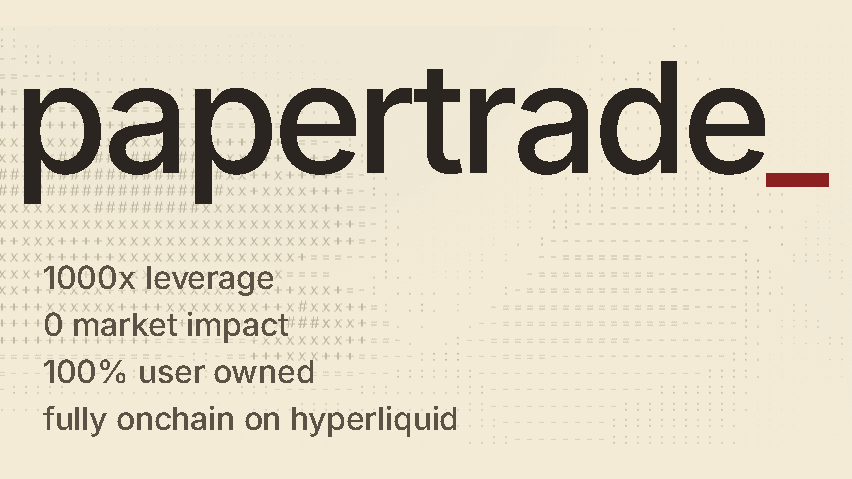
Papertrade is a new, fair-launched on-chain perpetuals DEX on Hyperliquid (HyperEVM) that mints its native token PAPER only through trading activity (losses). There are no founder tokens, no pre-mint, no team/VC allocation, no airdrop and no vesting. PAPER supply starts at 0 and grows inflationarily: each time traders lose (add USDC to the LP), PAPER is minted to the losing traders as a “loss-backed” token. Below a $2 M LP cap, the mint rate is a flat 100 PAPER per $1 of LP gain. Once the LP exceeds $2 M, the per-dollar mint rate begins to decay on a high-watermark curve (later LP gains mint fewer PAPER). PAPER holders can stake their tokens to earn a continuous share of the platform’s USDC revenue from trading (with extra staking rewards kicking in once the LP grows above $5 M). There are no token burns or sinks; all token issuance is purely tied to market losses. The official token contract is deployed on Robinhood Chain (chain ID 4663) at 0xAA3b129e4906009e228a060340601260de068ff5 (PAPER), and trading will ultimately settle on Hyperliquid’s HyperEVM.
No public exchange listings have been announced till 13 October 2026. The token’s primary “listing” is via on-chain liquidity built by trading itself (initially negligible) and community markets (e.g. a $3K market on Solana via Jupiter), but no CEX or official DEX listing has been confirmed till 13 October 2026. Given the ultra-high-leverage, no-fee design, trading volume could be volatile; liquidity is entirely self‑bootstrapped. This raises significant market risks: inflationary pressure and dilution from continuous emissions, uncertain demand if traders dump PAPER, and payout risk if the LP can’t cover winners (requiring FIFO queuing).
In a bull scenario with massive volume, the LP would grow quickly (unlocking extra staking rewards above $5 M) and PAPER could see strong demand from stakers; but supply would also spike (e.g. $1 M in losses mints 100 M PAPER), pressuring price.
In a bear scenario, low volume means low new issuance but also lower revenue to support price, and winners may struggle to withdraw funds if losses dry up. In short, PAPER is a speculative “loss token” whose value depends on sustained trading, LP health, and staking yields.
Papertrade’s own docs describe PAPER as a loss-issued, fee‑claim ERC20 with zero initial supply and no pre-allocations. Staked PAPER earns USDC from LP profits. Losses add USDC to the LP (called the “Martingaler LP”), and PAPER is minted to losing traders as rewards. The token’s only utility is sharing LP revenues (no governance or fixed rewards).All tokenomics come from official docs and on-chain logic: emission rules are flat-then-ratchet (100 per $1 until $2M); staking share is continuous USDC dividends.
PAPER has no intrinsic value apart from protocol participation. Its sole role is as an LP fee-claim token. The intended use cases are:
Fee Revenue Share: Staked PAPER holders earn a pro-rata share of protocol fees (converted to USDC) from the shared liquidity pool. Specifically, stakers automatically accrue USDC from traders’ losses/profits. Once the LP exceeds $5 M, any “excess” gains beyond that threshold are also routed to PAPER stakers. This creates a yield for token holders tied to trading volume.
Incentive for Losing Traders: PAPER is given only to traders who lose money on the platform. When a trader’s position closes at a loss (or is liquidated), their loss $L is sent to the LP and triggers minting of PAPER according to the emission curve. The losing trader receives the newly-minted PAPER. This acts as a “polluting mitigation” – losing traders get PAPER as a consolation prize. However, it does not reimburse their loss (the USDC loss stays in the LP).
No Governance or Voting: There is no mention of governance rights or token-holders’ votes. The project is described as “100% user owned” in the sense that no insiders hold tokens, but PAPER itself is not a governance token. Its value comes solely from future revenue claims, not protocol control.
No Trading Fees for Traders: The platform advertises zero trading fees and zero funding rates for users. In practice, this means PAPER and the LP mechanics replace the usual fee structure: rather than traders paying fees, winners are paid directly from the LP (if available) and losers replenish the LP (minting PAPER). The only implicit “fee” is the price impact/cost applied on closing profitable trades, which sends extra USDC to the LP.
Stake-to-Play: Until PAPER becomes transferable (the initial token model suggests it may be non-transferable at launch, only stakable), losing traders cannot immediately sell it. Instead they must stake PAPER to earn USDC. Over time, the token is expected to become freely tradable, but the main value proposition remains the staking rewards.
In summary, PAPER is purely a loss-token with staking utility. It grants holders a claim on future LP profits. Its issuance is “gameable” by taking losses, but its value depends entirely on continued volume (trading fees) and demand to stake or hold the token. As one analyst noted, PAPER is essentially a “loss-backed” token distributed in place of losses, so whether it has value hinges on growth of the protocol’s revenue pool.
Issuance & Emission Curve:
Official documentation and interviews describe the emission schedule precisely:
Flat Rate Phase (LP ≤ $2 M): While the LP total (net of queued payouts) is under $2,000,000, PAPER mints at 100 tokens per $1 of LP growth. For example, a $10,000 trader loss would mint 1,000,000 PAPER. This includes recovery from negative LP balances (the same 100:1 rate applies until the LP goes positive).
Decay Phase (LP > $2 M): After the LP surpasses $2M, the mint rate begins to decay using a high-watermark (ratchet) curve. In practice, initial documentation suggests a “flat-then-ratchet” default: a $2M threshold and a large decay scale (e.g. $120M). Roughly, this means each additional dollar of LP gain mints slightly fewer PAPER than the previous dollar. The exact curve is encoded on-chain (tracked via a trackedLpUsd that records peak LP). Importantly, the emission never resets to 100:1 when the LP shrinks – once you move past $2M of net growth, the lower mint rates persist (unless the LP falls back below zero, in which case the flat rate temporarily returns).
High-Watermark: The design uses a high-watermark (“trackedLpUsd”) so that once the protocol has advanced deep into the tail region above $2M, later pumping of PAPER is capped by the maximum historical LP, not just the current balance. This prevents scenarios where the LP grows, gets partially swept to stakers, and then the mint rate would otherwise spike again. Only a fall below the $2M threshold or to negative triggers the flat 100:1 floor to help rebuild the LP.
Minting to Traders: All PAPER minting is on-chain, automatic, and recorded. Contracts assign newly minted tokens directly to the losing traders responsible for the LP gain. There is no off-chain or hidden logic: issuance only occurs through the smart contracts when positions close at a loss.
No inflation cap or deflation mechanism is mentioned. Thus, total supply will grow without bound as long as losses occur. Commentators warn this leads to dilution: issuing more PAPER after each loss broadens distribution but also dilutes existing holders if revenue (LP growth) doesn’t keep pace. If growth stalls, PAPER holders bear the full inflation effect.
Staking and Rewards:
PAPER’s primary utility is staking. The system works as follows:
Staking Entitlement: Staking PAPER grants a pro-rata share of all USDC revenues flowing into the LP. In simple terms, every time the LP gains USDC (from trader losses or impact fees on winners), a percentage is diverted to stakers. This is distributed continuously to stakers in USDC.
Revenue Sources: Since traders pay no fees, the only revenue to the LP comes from price impact on profitable trades and losing trades themselves. In effect, stakers earn part of every losing trader’s cash injection. The exact share mechanism is built into the smart contracts (not publicly detailed in the docs), but the marketing says stakers earn LP revenue in USDC.
5M Cap Bonus: A key parameter is the $5,000,000 threshold. Once the LP’s accumulated value exceeds $5M, extra USDC can be “swept” to stakers. Concretely, normal protocol “fees” go partly to the LP and partly to stakers; when LP > $5M, a larger slice flows to stakers. This aligns stakers with deep pool growth (they earn more when the system is healthy). No similar bonus is mentioned for when LP is below $5M.
No Governance Voting: Staking PAPER does not confer governance votes or any rights beyond revenue. It simply locks tokens to earn yield.
Lock-up/Unstaking: The documentation does not detail lock-up times or penalty, but given the “no-vesting” ethos, unstaking is presumably free and immediate. The only incentive to lock longer would be yield mechanisms (if implemented) or tiered rewards (none specified except the 5M trigger).
In summary, PAPER staking turns the token into a yield-bearing asset tied to platform revenue. The strength of the reward depends entirely on trading volume (more volume → more LP gains → more USDC revenue to share).
Listing & Market Status:
No official exchange listings are announced as on 13 October 2026. Papertrade’s public channels (docs and tweets) mention only the on-chain trading interface and fair-launch plan. The token’s initial distribution occurs on-chain; it was revealed via a Robinhood chain sale/launchpad on Oct 7, 2026.
The only planned “liquidity” per docs is the Martingaler LP which starts at $0. Users cannot add liquidity themselves. All trading liquidity must be generated by the protocol via losses. Thus, initial liquidity on launch was effectively zero until trading began.
Given Papertrade’s novel model (no order book, no external LPs), conventional listing strategies (seed liquidity, market makers) do not apply. The team has not announced any listing partnerships. It’s possible PAPER could later be bridged to Ethereum or Arbitrum with liquidity on Uniswap-like DEXes, but no roadmap is given as on 13 october 2026.
We judge “planned listing timeline” unspecified. The fair-launch theme suggests no private or ICO, but also implies minimal promotion. If any, listings might only come after some track record. For now, liquidity is extremely low and listing on venues should be considered speculative and unlikely in the short term.
Trading & Price Outlook:
Liquidity & Depth: The only deep pool is the Martingaler LP, which starts at $0 and grows with losses. Early trading (especially in the first weeks) will face shallow liquidity: wins by traders will quickly deplete the LP and trigger the FIFO payout queue, as warned by the team. On-chain data should be watched for queue lengths. Price stability is highly uncertain until the LP accumulates a meaningful reserve. Any single large win (e.g. a 1000x leveraged position) could drain the LP and shift the market price dramatically.
Inflationary Pressure: PAPER is strongly inflationary. For example, every $1 of losses mints 100 tokens (under $2M LP). In a bull run with heavy volume (say $10M of losses), that means 1,000,000,000 PAPER could be minted. Without sinks, this dilutes existing supply. If demand (staking or trading) doesn’t scale equally, token price will suffer. Past emission curves (e.g. FCoin’s trade-to-mine) showed tokens oversupplied quickly, crashing value. PAPER faces a similar risk: each trade amplifies supply. Practically, holders can only realize value if enough traders buy PAPER (out of staking or speculation) to absorb new supply.
Bull Scenario: High-volume usage drives LP > $5M (unlocking extra staking rewards) and many losses → heavy issuance. If PAPER becomes widely accepted, staking yields could buoy price. But even in this best case, token supply could be vast. For example, if the LP grew from $0 to $5M, the first $2M adds 200M tokens; the next $3M (slower rate) might add ~300M more (total ~500M). At $1.00 per token, that’s $500M market cap; but if price is lower (say $0.10), market cap is $50M. It’s unclear what valuation PAPER could sustain. (By contrast, total revenue in a given week might only be small millions, so $0.10 might already price-in high future earnings.)
Bear Scenario: Low volume means few new tokens and little LP growth. Early holders (especially loss generators) would have minted tokens at high rates, but find few buyers. Without new LP gains, stakers earn little, so staking incentive fades. Many participants could dump PAPER, collapsing the price. The LP itself may deplete (queuing winners), undermining confidence in the system’s payout ability. In a bearish market, Papertrade’s model is untested; historically, “giveaway” tokens from losses often crash once promotions end. PAPER lacks natural sinks (no buyback or burn), so prolonged bear pressure could lead to a steep decline.
Comparables: Analysts compare Papertrade’s model to FCoin’s “trade-to-mine” and its 2020 collapse. Both give tokens to traders, but Papertrade is worse: only losers get tokens, and tokens can’t be redeemed for lost funds. Like FCoin, Papertrade’s math is transparent (on-chain), but it still forms an open-ended pyramid where future trading losses are needed to pay current winners and justify current token holders.
Quantitative Example: If 1,000 traders each lose $100 (total $100k to LP), under the flat rate they’d collectively mint 10,000,000 PAPER. If no one buys that PAPER (staking or in market), its price would collapse (e.g. if each token were $0.001, the loss per trader would be only covered by 10,000 tokens worth $10; a far cry from the $100 lost). To offer any recovery, PAPER’s price would need to be fairly high. Conversely, if LP grows $100k and PAPER price is $0.01, those 10M tokens are worth $100k – matching the LP injection. But achieving that requires either strong demand or enormous staking lock-ups. Such dynamics make price highly sensitive to volume, with extreme inflationary risk if growth falters.
Overall, PAPER’s future price depends on a delicate balance: LP health (profitability of trading), emission rates (dilution), and token demand (staking vs selling). Small changes in volume or sentiment could swing price wildly.
Monitoring Points
Launch & Mainnet: Watch for the official trading launch and the end of any deposit window. The team mentioned a pre-announced deposit phase (in Oct 2026). The actual launch time (Aug 2026 launch target shifted to Oct) and first trades will set initial LP and token flows.
Contract Audits: Guardian Audits engagement was announced for Summer 2026. The audit report (when published) should be reviewed for any hidden fees, mint logic, or restrictions. Security issues could also impact price.
LP Milestones ($2M, $5M): The emission curve hinges on $2M and $5M thresholds. Whether and when the LP surpasses $2M is critical: below it, incentives are strongest (100:1); above it, issuance slows. Similarly, $5M triggers extra staking rewards. On-chain explorers or the team’s dashboard should be checked for LP balance. These are game-changing events for tokenomics.
FIFO Queue Usage: Track if the LP ever hits zero and payments queue up. Frequent queuing (winners waiting for funds) would alarm traders and could signal imminent troubles. Low queue activity suggests a healthy LP.
Emission Parameters: The contracts likely allow parameter changes (the cryptoway guide mentions “configurable parameters”). Monitor GitHub or docs for any changes to the 100:1 rate, thresholds, or decay scale. If the team adjusts these (e.g. to curb inflation), it will impact long-term supply.
Token Transfers/Lock-Up: If PAPER is non-transferable initially (as implied), note when that lock lifts. The value is tied to ability to trade or stake. Any vesting for early stakers (PaperDAO arrangement suggests lock periods) should also be watched.
Exchange Listings: Any announcements of CEX listings (Robinhood Chain exchanges or bridges to EVM chains) will affect liquidity and price discovery. Given the unique chain (4663), check new DEXs listing Robinhood assets or any bridging to mainnets.
Market Sentiment & Volume: Monitor trading volume and prices on on-chain DEXs (like Jupiter or any emerging DEXes on HyperEVM). Sudden spikes in volume can indicate whale activity or pump, while prolonged low volume may precede a dump.
Competitive/Catch-up Projects: Watch if similar “synthetic loss-token” projects emerge or if regulators scrutinize this novel model (centralized control is low, but “Ponzi-like” critiques may invite attention).
Overall, key metrics to watch are LP size, staking yields, token supply growth, and queue length. These on-chain numbers – more than price charts – will signal the protocol’s health.
Mermaid Diagrams: The token flow and dynamics can be summarized as follows:
Members Only
Continue Reading with a Free CryptoEdy Account.
Join thousands of investors who rely on CryptoEdy for curated research, market intelligence, and actionable insights — completely free.
What You'll Get
Curated research: Analysis and deep-dives vetted by our editorial team.
Market intelligence: Stay ahead with real-time insights and macro narratives.
Community access: Join 15,000+ investors sharing alpha and strategies.
Our team includes former institutional analysts, on-chain researchers, and DeFi-native traders with a combined 30+ years in traditional and crypto markets.
How should I use this research?
Our reports are educational and informational. They are not financial advice. Always do your own research and consult a financial advisor before making investment decisions.
How often do you publish reports?
We operate at the speed of the market, providing daily insights, real-time briefings, and essential emergency alerts. While the digital asset space is defined by its rapid pace, Cryptoedy Research is engineered to outpace it. Our intelligence suite includes exhaustive bi-weekly deep-dives and high-impact macro updates. Beyond scheduled reports, we issue tactical trade alerts dynamically as market opportunities materialize.
How often are articles updated?
Published articles are updated when material changes occur — price target hits, thesis invalidation, or new on-chain data. Updated articles are marked with a revision date.
What is the 3X Value Guarantee?
If you follow our documented high-conviction calls with standard risk management for a full year and do not realize at least 3x the cost of your subscription in profit, we will refund your year or grant another year free.
Can I cancel my subscription anytime or Is there a money-back guarantee policy?
Members have the flexibility to cancel their subscription within 30 days, We provide a full, no-questions-asked refund.
After the refund period, you retain access to our free tier, which offers limited market trends, research, and insights.
While we regret any member's departure from the Cryptoedy community, we respect your decision and welcome the opportunity to serve you again in the future.
Can I pay with cryptocurrency?
Yes. We accept USDT/USDC cryptocurrency across 85+ EVM and Solana-compatible chains, powered by our Universal Bridge for seamless swaps and cross-chain support.
For streamlined transactions, we natively support USDT and USDC on the Ethereum, Arbitrum, and Solana networks through our secure checkout portal. Users can pay directly from non-custodial wallets like MetaMask, benefiting from automatic routing to ensure optimal liquidity and a unified experience—no fragmented assets required.
Can I Use International Credit Cards?
Yes. We accept most international credit cards—including Visa, Mastercard, and American Express—from over 100 countries. Payments are processed through Thirdweb Checkout, one of the world’s most trusted and secure gateways, featuring support for global transactions and dynamic currency conversion.
Is it recommended for beginners?
Whether you are just starting your journey or are an expert trader, Cryptoedy Research provides the edge you need. PRO Membership includes real-time market insights, strategic coin picks, and in-depth technical research designed to navigate complex market cycles.
Can I share articles with others?
Free articles can be shared freely. Pro articles are for subscribers only — sharing paywalled content violates our terms of service.
What results can I expect?
Success depends on your individual strategy and risk profile, but PRO Membership ensures you never move in the dark. Our research and real-time insights provide the edge necessary to interpret market shifts and secure a position ahead of the competition.
Do you provide Buy Sell Signals?
We deliver comprehensive research reports featuring precise price targets, technical support and resistance levels, and structured entry-to-exit frameworks. Our objective is to empower you with data-driven intelligence for informed decision-making, moving beyond the limitations of speculative signals.
What does the risk rating mean?
Risk ratings (Low, Medium, High, Very High) reflect the volatility and uncertainty of the asset or thesis. Higher risk means larger potential swings in both directions. Position size accordingly.