Bitcoin Direction after Clarity Act and Fed Rate Hike after 16 September 2026 | CryptoEdy
PROWhale Analytics & Intelligence
Bitcoin Direction after Clarity Act and Fed Rate Hike after 16 September 2026
CE
Lead Analyst
Sep 16, 202611 min read
Bitcoin Market Structure & Macro Analysis -Bitcoin finally absorb both bad news, Bitcoin Direction towards uptrend
Bitcoin at the Inflection Point: Can $75K Support Trigger the Next Move Toward $81K and Beyond?
CryptoEdy Research | Bitcoin Market Structure & Macro Analysis | September 2026
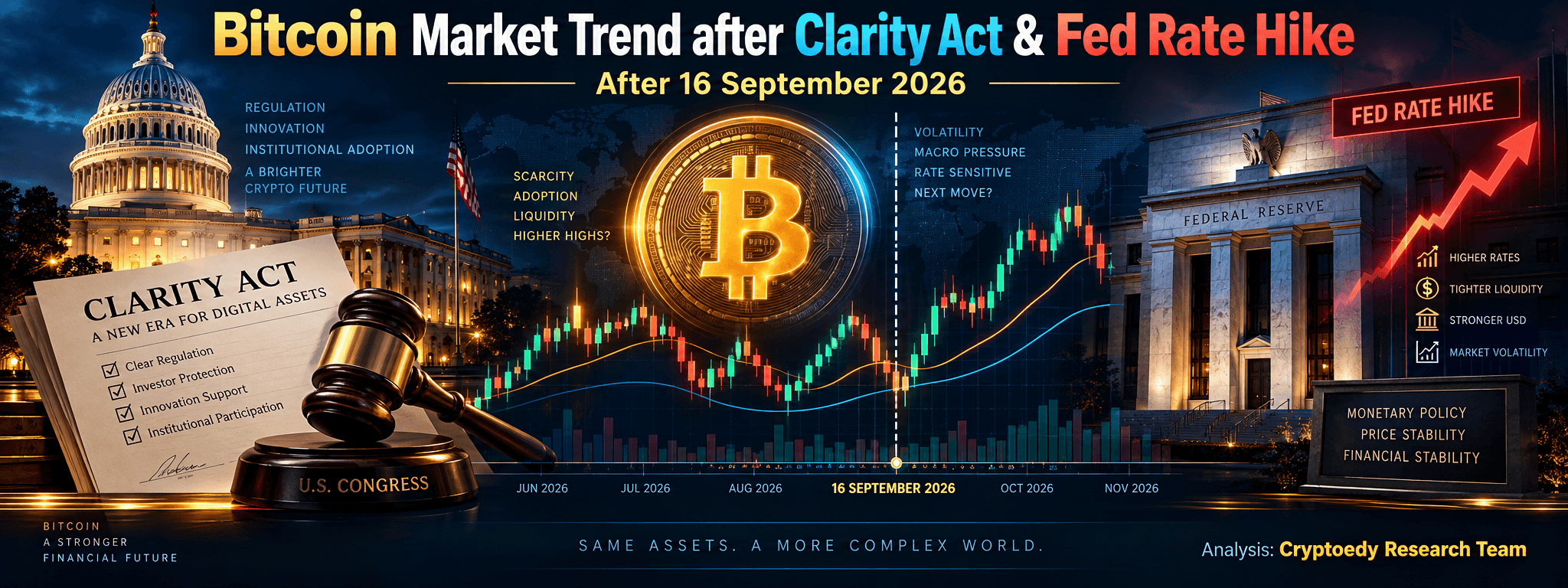
Bitcoin is entering a critical market-structure phase after absorbing two major September catalysts: the failure of the CLARITY Act to advance in the U.S. Senate and the Federal Reserve's 25-basis-point rate increase.
On September 15, the U.S. Senate failed to advance the CLARITY Act in a procedural vote, with the motion receiving 49 votes in favor and 50 against, below the 60 votes required to advance the legislation. The bill is intended to establish a federal regulatory framework for digital assets and clarify aspects of the regulatory roles of the SEC and CFTC.
The following day, the Federal Reserve raised its target federal funds rate by 25 basis points to a range of 3.75%–4.00%. Bitcoin initially experienced volatility but remained around the mid-$75,000s, reinforcing the importance of the $75K–$76K area as a near-term market-structure zone.
The more important question for Bitcoin is therefore no longer simply whether these events are bullish or bearish. The key question is whether BTC can absorb the negative catalysts while defending its recent support structure.
Our current framework is:
$75K–$76K support → stabilization → recovery toward $78K → $80K–$81K resistance test → potential breakout → $86K–$92K
A sustained breakdown below $75K would invalidate this near-term bullish structure and could expose Bitcoin to lower support levels.
1. The CLARITY Act: From Regulatory Catalyst to Market Test
On August 19, 2026, President Donald Trump called on Congress to advance the CLARITY Act during a White House meeting involving senior cryptocurrency-industry executives. Reporting at the time described the legislation as a major industry priority intended to establish clearer federal rules for digital assets.
The legislation became an important part of the broader U.S. crypto-regulation narrative because it sought to establish clearer rules around the treatment and regulatory oversight of digital assets.
However, the Senate subsequently failed to advance the legislation.
On September 15, the Senate procedural vote ended 49–50, falling short of the 60 votes required. The result represented a significant setback for the legislation, although reporting indicates that the bill was stalled rather than necessarily eliminated from future consideration.
Bitcoin initially reacted negatively, with BTC moving toward the mid-$75,000 area.
The key market observation, however, is that Bitcoin did not establish a sustained breakdown beneath the $75K region.
That distinction matters.
Members Only
Continue Reading with a Free CryptoEdy Account.
Join thousands of investors who rely on CryptoEdy for curated research, market intelligence, and actionable insights — completely free.
What You'll Get
Curated research: Analysis and deep-dives vetted by our editorial team.
Market intelligence: Stay ahead with real-time insights and macro narratives.
Community access: Join 15,000+ investors sharing alpha and strategies.
The CLARITY Act setback was followed by another major market event.
On September 16, the Federal Reserve raised the federal funds target range by 25 basis points to 3.75%–4.00%. It was the first Fed rate increase since 2023.
Because the rate increase had been widely anticipated by markets, the initial reaction was more contained than it might have been if the decision had been a surprise.
Bitcoin briefly experienced volatility before stabilizing around the mid-$75,000 area. Contemporary market reporting described the rate hike as largely anticipated and noted that Bitcoin's response was relatively contained.
This creates an important technical question:
If Bitcoin can absorb both the CLARITY Act setback and the Fed hike without losing $75K decisively, is the market beginning to price these risks into BTC?
The answer cannot be known with certainty, but the price structure provides an important area to monitor.
3. The $75K–$76K Zone Becomes the Critical Battlefield
The $75,000–$76,000 region has emerged as an important near-term support area.
Market analysis published before the September events had already identified approximately $75K–$76.5K as an important Bitcoin support region, while the $81K–$86K area was identified as a broader resistance zone.
This produces a relatively clear market structure:
As long as Bitcoin continues to defend the lower support zone, the market can remain in a consolidation-and-recovery structure.
A decisive breakdown, however, would materially weaken this thesis.
4. Bitcoin ETF Flows: A Critical Variable
Institutional ETF demand remains one of the most important variables for Bitcoin's market structure.
However, the September data do not support describing ETF flows as continuously positive.
This volatility suggests that ETF flows should be treated as a confirmation indicator rather than a standalone bullish signal.
The key question is whether net ETF demand can return to a sustained positive trend following the recent regulatory and macroeconomic shocks.
If inflows strengthen while Bitcoin continues defending $75K–$76K, the combination could provide stronger evidence of demand absorption.
5. Coinbase Premium: Watch U.S. Spot Demand
The Coinbase Premium is another important indicator for evaluating U.S.-based spot demand.
However, the latest available data following the CLARITY Act vote showed the Coinbase Premium Index falling to approximately −0.079, its lowest level since August 16.
Therefore, rather than assuming that Coinbase Premium is already providing a strong bullish confirmation, traders should monitor whether it recovers back into positive territory.
A transition from negative to positive Coinbase Premium, combined with improving ETF flows and stable BTC price action, would provide a stronger confirmation of renewed U.S. spot demand.
6. Potential Short-Squeeze Structure
The next major variable is the derivatives market.
If Bitcoin stabilizes around $75K–$77K while leveraged traders continue positioning for downside, an upside move through $78K could force short positions to close.
That could create the following potential sequence:
$75K support defended
↓
BTC consolidates
↓
$78K reclaimed
↓
Short positions become increasingly vulnerable
↓
$80K psychological resistance tested
↓
$81K breakout attempt
↓
Short liquidations accelerate
↓
$82K–$86K resistance zone
This is a scenario, not a prediction.
Confirmation would require actual price action, derivatives positioning, funding rates, open interest and liquidation data.
The bullish scenario would require several conditions to develop together.
Potential sequence:
$75K–$76K holds
→ ETF flows stabilize or turn sustainably positive
→ Coinbase Premium recovers
→ Spot buying strengthens
→ BTC reclaims $78K
→ $80K is tested
→ $81K breaks decisively
→ Short liquidations increase
→ BTC targets $82K–$86K
→ $90K–$92K becomes the next major resistance zone
Under a substantially stronger bullish environment, Bitcoin could eventually move toward higher six-figure levels.
The $130K scenario before December 2026 should be treated as a high-end bullish scenario requiring significant confirmation rather than as a base-case expectation.
9. Base Scenario
Extended $75K–$81K Consolidation
The base market-structure scenario is continued consolidation.
Bitcoin could remain between approximately:
$75K support
and
$80K–$81K resistance
for an extended period while the market evaluates:
Federal Reserve policy
ETF flows
Treasury yields
U.S. dollar liquidity
regulatory developments
derivatives positioning
institutional spot demand
Under this scenario, volatility could remain elevated without producing a decisive trend.
A breakout above $81K or breakdown below $75K would provide greater directional information.
10. Bear Scenario
$75K Support Fails
The bearish scenario becomes more relevant if Bitcoin loses the $75K–$76K support zone on a sustained basis.
Potential confirmation signals would include:
Persistent ETF outflows
Negative Coinbase Premium
Increasing exchange inflows
Weak spot demand
Rising selling pressure
Breakdown in market structure
Failure to reclaim $76K–$78K after a breakdown
Under this scenario, the market could begin searching for lower support zones.
The most important point is that $75K should not be treated as an absolute floor. Technical support can fail when liquidity, leverage and macro conditions shift.
11. Key Catalysts:
Bullish Catalysts:
1. Sustained Positive ETF Flows
A persistent return of institutional ETF demand could provide additional spot-market support.
2. Positive Coinbase Premium
A recovery in Coinbase Premium could indicate improving U.S. spot demand.
3. Break Above $81K
A decisive breakout could change the short-term market structure.
4. Short Liquidations
A rapid move higher could force leveraged shorts to close positions, potentially accelerating momentum.
5. Regulatory Progress
Although the CLARITY Act failed to advance in the September 15 procedural vote, broader regulatory developments remain relevant to the digital-asset market.
6. Improving Liquidity Conditions
Changes in Treasury yields, dollar liquidity and broader risk appetite could materially affect Bitcoin's ability to sustain an upside move.
12. Key Risks:
1. Loss of $75K Support
A decisive breakdown below $75K would weaken the current bullish market structure.
2. Continued ETF Outflows
Recent ETF data demonstrate that institutional flows can reverse quickly. Continued outflows could create additional spot-market selling pressure.
3. Negative U.S. Spot Demand
A persistently negative Coinbase Premium could indicate weaker U.S. demand.
4. Higher-for-Longer Monetary Policy
The Federal Reserve's 25-basis-point hike demonstrates that monetary policy remains an important macro variable. Further tightening or a less accommodative policy path could weigh on risk assets.
5. Failure at $80K–$81K
Repeated rejection around $80K–$81K could encourage profit-taking and renewed short positioning.
6. Leverage and Liquidations
High leverage can amplify moves in both directions. A failed breakout could therefore produce a rapid reversal.
7. Regulatory Uncertainty
The CLARITY Act's failure to advance highlights the continuing uncertainty surrounding the development of a comprehensive U.S. digital-asset market structure.
13. CryptoEdy Market Framework:
Our current framework can be summarized as:
$75K–$76K
Critical support
↓
$77K–$78K
Recovery / momentum zone
↓
$80K
Psychological resistance
↓
$81K
Critical breakout level
↓
$82K–$86K
Next resistance zone
↓
$90K–$92K
Major higher resistance
↓
$130K
High-end bullish scenario
The market's next major directional signal is therefore likely to come from the interaction between $75K support and $81K resistance.
14. CryptoEdy Conclusion:
Bitcoin is currently positioned at an important market-structure inflection point.
The failure of the CLARITY Act to advance in the Senate and the Federal Reserve's 25-basis-point rate hike created two significant sources of uncertainty within a very short period. Yet Bitcoin has continued to trade around the mid-$75,000s rather than establishing a sustained breakdown below the $75K region.
The immediate focus should therefore remain on price acceptance rather than headlines.
For the bullish structure to strengthen, Bitcoin would need to defend $75K–$76K, reclaim $78K, challenge $80K, and ultimately establish a sustained breakout above approximately $81K.
If that sequence occurs alongside improving ETF flows, recovering Coinbase Premium, stronger spot demand and favorable derivatives positioning, the market could begin targeting the $82K–$86K region, followed by $90K–$92K.
Conversely, a sustained breakdown below $75K would invalidate this near-term bullish structure and require a reassessment of the market's downside risk.
The $75K–$81K range is therefore the key battlefield.
For CryptoEdy Research, the central question is not whether Bitcoin must move higher or lower. The critical question is:
Will Bitcoin continue absorbing negative catalysts above $75K, and can buyers ultimately convert that absorption into a confirmed breakout above $81K?
That is the price structure the market needs to resolve next.
CryptoEdy Research Disclaimer:
This report is provided for informational and educational purposes only and does not constitute investment advice, financial advice, trading advice, legal advice, or a recommendation to buy, sell, hold, or otherwise transact in Bitcoin or any other digital asset.
CryptoEdy's analysis is based on publicly available information, market data, technical observations, macroeconomic developments, regulatory developments, and analytical assumptions that may change without notice. Cryptocurrency markets are highly volatile and can experience rapid and substantial price movements. Historical price behavior, technical patterns, ETF flows, derivatives data, liquidity indicators, regulatory developments, or other market signals do not guarantee future results.
The bullish, base-case, and bearish scenarios described in this report are analytical scenarios rather than predictions or guarantees. Price levels such as $81K, $86K, $90K, $92K, or $130K are analytical reference points and should not be interpreted as assured future targets.
Readers should conduct their own research and consider their financial circumstances, investment objectives, risk tolerance, and time horizon before making any investment or trading decision. Leveraged cryptocurrency trading can result in losses exceeding the initial capital committed.
CryptoEdy does not guarantee the accuracy, completeness, timeliness, or reliability of the information presented and is not responsible for losses arising from reliance on this material.
Always verify market prices, regulatory developments, ETF flows, macroeconomic data, and other time-sensitive information independently before making financial decisions. Unlock The Full Access Here:
Our team includes former institutional analysts, on-chain researchers, and DeFi-native traders with a combined 30+ years in traditional and crypto markets.
How should I use this research?
Our reports are educational and informational. They are not financial advice. Always do your own research and consult a financial advisor before making investment decisions.
How often do you publish reports?
We operate at the speed of the market, providing daily insights, real-time briefings, and essential emergency alerts. While the digital asset space is defined by its rapid pace, Cryptoedy Research is engineered to outpace it. Our intelligence suite includes exhaustive bi-weekly deep-dives and high-impact macro updates. Beyond scheduled reports, we issue tactical trade alerts dynamically as market opportunities materialize.
How often are articles updated?
Published articles are updated when material changes occur — price target hits, thesis invalidation, or new on-chain data. Updated articles are marked with a revision date.
What is the 3X Value Guarantee?
If you follow our documented high-conviction calls with standard risk management for a full year and do not realize at least 3x the cost of your subscription in profit, we will refund your year or grant another year free.
Can I cancel my subscription anytime or Is there a money-back guarantee policy?
Members have the flexibility to cancel their subscription within 30 days, We provide a full, no-questions-asked refund.
After the refund period, you retain access to our free tier, which offers limited market trends, research, and insights.
While we regret any member's departure from the Cryptoedy community, we respect your decision and welcome the opportunity to serve you again in the future.
Can I pay with cryptocurrency?
Yes. We accept USDT/USDC cryptocurrency across 85+ EVM and Solana-compatible chains, powered by our Universal Bridge for seamless swaps and cross-chain support.
For streamlined transactions, we natively support USDT and USDC on the Ethereum, Arbitrum, and Solana networks through our secure checkout portal. Users can pay directly from non-custodial wallets like MetaMask, benefiting from automatic routing to ensure optimal liquidity and a unified experience—no fragmented assets required.
Can I Use International Credit Cards?
Yes. We accept most international credit cards—including Visa, Mastercard, and American Express—from over 100 countries. Payments are processed through Thirdweb Checkout, one of the world’s most trusted and secure gateways, featuring support for global transactions and dynamic currency conversion.
Is it recommended for beginners?
Whether you are just starting your journey or are an expert trader, Cryptoedy Research provides the edge you need. PRO Membership includes real-time market insights, strategic coin picks, and in-depth technical research designed to navigate complex market cycles.
Can I share articles with others?
Free articles can be shared freely. Pro articles are for subscribers only — sharing paywalled content violates our terms of service.
What results can I expect?
Success depends on your individual strategy and risk profile, but PRO Membership ensures you never move in the dark. Our research and real-time insights provide the edge necessary to interpret market shifts and secure a position ahead of the competition.
Do you provide Buy Sell Signals?
We deliver comprehensive research reports featuring precise price targets, technical support and resistance levels, and structured entry-to-exit frameworks. Our objective is to empower you with data-driven intelligence for informed decision-making, moving beyond the limitations of speculative signals.
What does the risk rating mean?
Risk ratings (Low, Medium, High, Very High) reflect the volatility and uncertainty of the asset or thesis. Higher risk means larger potential swings in both directions. Position size accordingly.