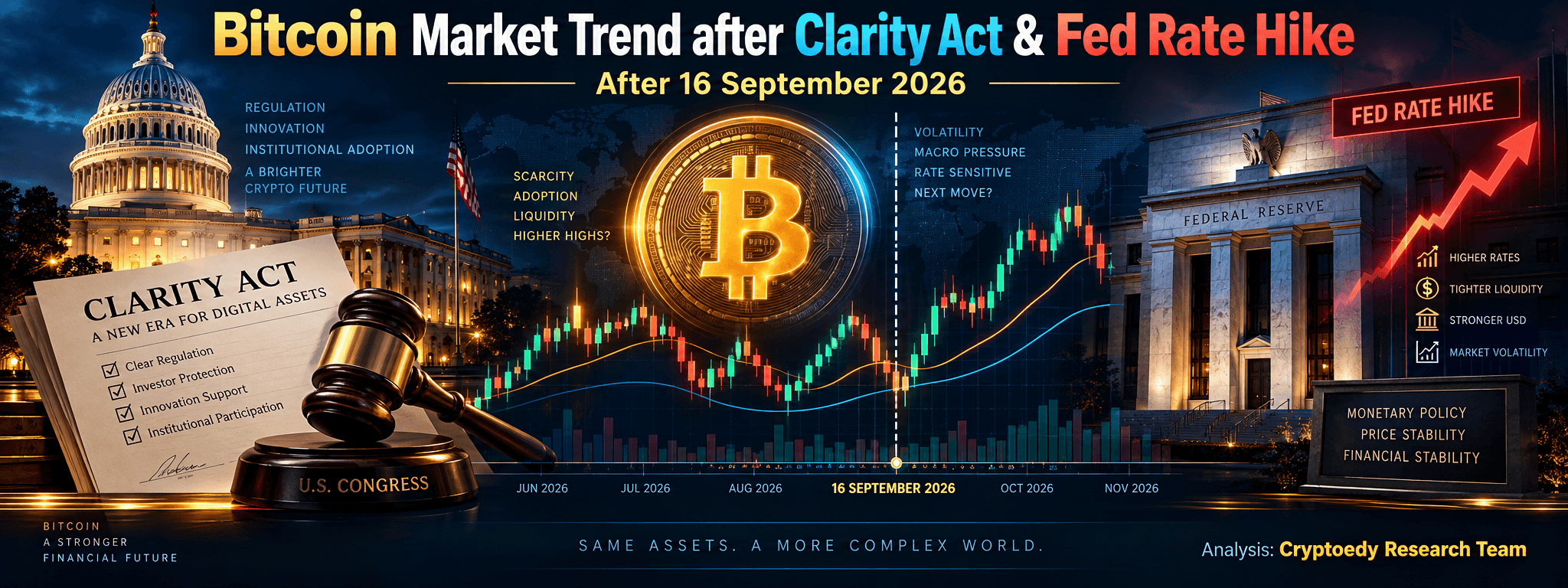
The Great Accumulation: How Crypto Whales Are Engineering the Next Bull Market From the Ruins of Retail Panic- Bitcoin -Signaling a $59K–$63K July–Aug 2026-bottom-Our wild Prediction
On-Chain Intelligence Report: March – June 2026 | Cryptoedy Analytics Division
While retail investors capitulate into "Extreme Fear," the largest holders in crypto are executing one of the most sophisticated and deliberate accumulation campaigns in blockchain history. This is what the data reveals — and what it means for the next six months.
Introduction: The Divergence That Defines This Market
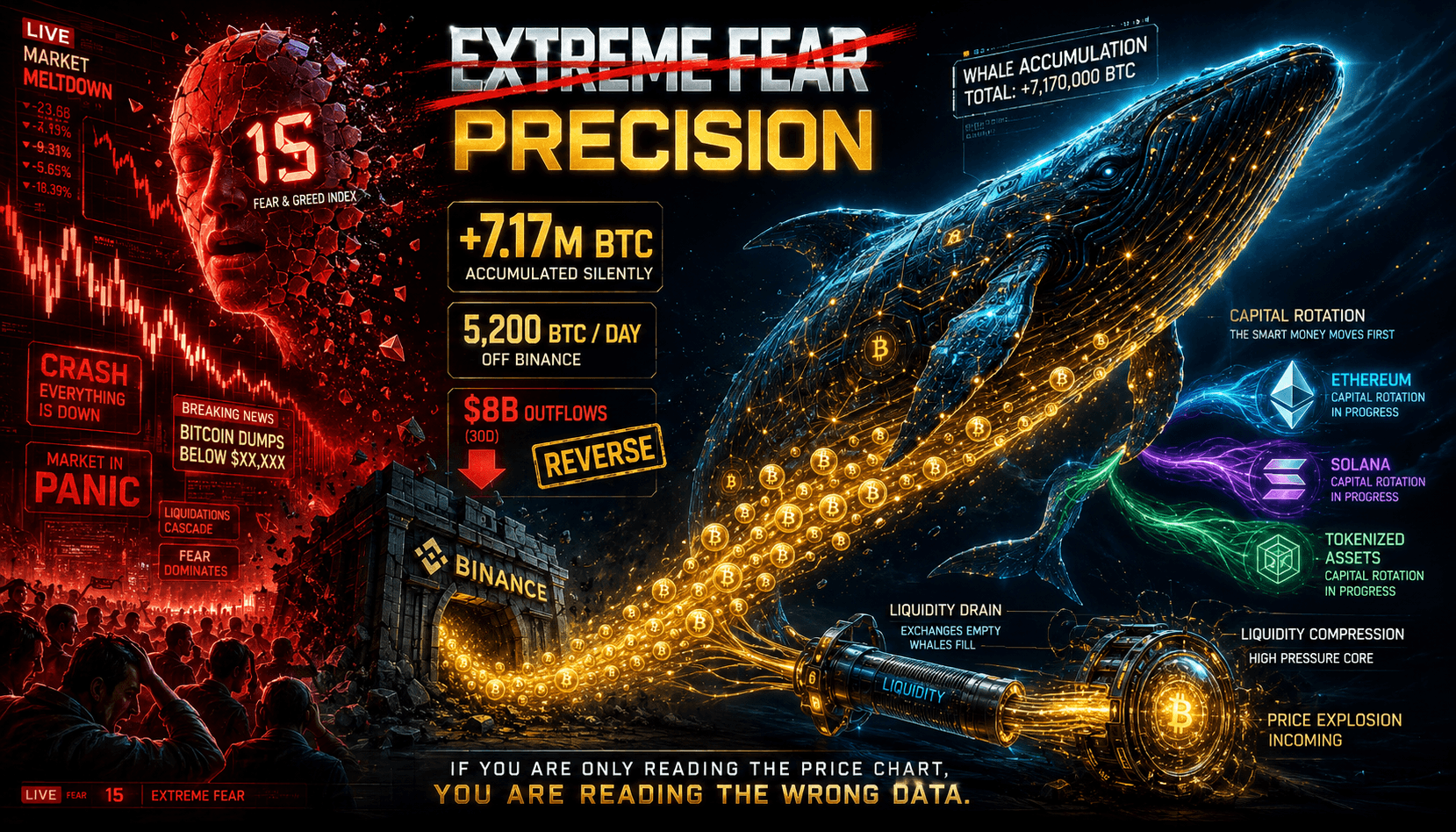
There is a pattern that repeats in every major crypto cycle, and it is playing out with textbook precision in the first half of 2026. While the Fear and Greed Index plunges to readings of 15 — a level categorized as Extreme Fear, last seen during the depths of the 2022 collapse — the on-chain data tells a radically different story beneath the surface.
Whale Bitcoin holdings have rebounded to 7.56 million BTC by June 2026, representing one of the fastest and most concentrated accumulation episodes since the post-FTX capitulation of late 2022. Exchange outflows are sustained and accelerating. Cold storage movements are at multi-year highs. And across Ethereum, Solana, and a select group of foundational DeFi protocols, large capital allocators are rotating with precision into positions that retail participants are abandoning in panic.
This is not a story about buying the dip. This is a story about structural market engineering — and understanding it requires moving beyond price charts into the deeper intelligence layer that on-chain data uniquely provides.
The Great Accumulation: Mapping the Structural Shift (March – June 2026)
The Setup: Engineered Fear as an Acquisition Opportunity
To understand what is happening in June 2026, we need to trace the architecture backward to March, when the structural conditions for this accumulation phase were first being laid.
In March 2026, the broader crypto market was navigating a complex macro environment: residual uncertainty around Federal Reserve policy direction, intermittent ETF flow disruptions creating surface-level bearish narratives, and a Solana ecosystem experiencing both extraordinary trading volume and concentrated attention from large capital pools. The confluence of these factors created the ideal psychological environment for sophisticated accumulation — visible enough fear to suppress retail participation, but not severe enough to trigger genuine protocol-level capitulation.
Whale behavior in this period began showing the early signatures of what on-chain analysts would later identify as a coordinated structural accumulation campaign:
- Exchange net outflows turned consistently negative across major venues — meaning more Bitcoin was leaving exchanges than arriving
- Whale cohort holdings began inflecting upward after a period of relative flatness in late 2025
- UTXO (Unspent Transaction Output) age bands began shifting — newer coins were being held rather than moved to exchanges, a classic holding signal
By April, the pattern had intensified. By June, it had become unmistakable.
The Intelligence Architecture: Five Layers of Whale Decision-Making
What separates whale behavior from retail behavior is not simply capital size — it is the sophistication of the analytical framework guiding their decisions. In this cycle, that sophistication is operating on at least five distinct levels simultaneously.
Intelligence Layer 1: Macro-Awareness and Federal Reserve Positioning
The largest crypto holders in 2026 are not crypto-native speculators in the traditional sense. They are capital allocators who view Bitcoin and select digital assets through a macro lens identical to how a global macro hedge fund views gold, emerging market currencies, or inflation-linked bonds.
Their central thesis for this accumulation phase is anchored in a specific macro assumption: that the Federal Reserve is approaching an inflection point — whether through the resumption of quantitative easing in response to economic deterioration, a pivot toward rate cuts, or the structural erosion of confidence in the dollar-denominated financial system that typically precedes capital rotation into hard asset alternatives.
This is not a new thesis — it is the same thesis that drove the 2020–2021 cycle. But in 2026, it is being executed with greater conviction and more sophisticated hedging structures, because the macro backdrop — elevated global debt levels, persistent inflationary pressures in non-US economies, and expanding sovereign balance sheets — has become structurally more supportive of the Bitcoin narrative than at any previous period.
Whales are not buying Bitcoin because they believe it will go up next week. They are buying Bitcoin because they believe the macro conditions that created the 2020–2021 bull run are reassembling — and they are positioning before those conditions become visible to the broader market.
Intelligence Layer 2: Supply Shock Engineering
This is perhaps the most sophisticated element of whale strategy in this cycle, and it is the one most poorly understood by retail participants.
The movement of Bitcoin off exchanges and into cold storage — which has accelerated dramatically between March and June 2026 — is not passive investment behaviour. It is an active market structure intervention. By removing Bitcoin from exchange order books, whales are doing two things simultaneously:
First, they are reducing liquid supply. When 5,200+ BTC leave Binance in a single day (as occurred on June 15th), the available float on that exchange's order books compresses. The same demand that previously moved price by one unit now moves it by a larger unit — the price sensitivity of the market increases.
Second, they are engineering the conditions for a liquidity squeeze. When retail FOMO eventually returns — triggered by a news catalyst, a macro shift, or simply the natural exhaustion of the bear narrative — the reduced exchange-side supply means that buy-side pressure encounters a thinner order book than in previous cycles. The price response to equivalent buying pressure will be amplified.
This is not a theory about what whales might be doing. It is the structural mechanics of what the on-chain data shows is happening. The sustained reduction in exchange-held Bitcoin supply, combined with the parallel increase in cold storage movements, is the fingerprint of coordinated supply-side restriction — designed to maximise the price impact of the demand surge that whale cohorts anticipate.
Intelligence Layer 3: Data-Driven Undervaluation Identification
Institutional-grade crypto investors in 2026 do not rely on price charts alone. They operate with a suite of on-chain valuation metrics that provide a fundamentally different picture of asset value than market price in isolation.
The three most critical metrics guiding whale decisions in this period are:
MVRV (Market Value to Realized Value): This ratio compares the current market capitalization to the total cost basis of all Bitcoin in existence (the "realized" value — what everyone paid for their Bitcoin when it last moved). An MVRV below 1.0 indicates that the average holder is underwater — a historically reliable signal of market bottoms. In June 2026, with the key cost basis range for major whale cohorts estimated at $48,000–$56,000, MVRV data has been signalling the kind of undervaluation that has preceded every major Bitcoin recovery in its history.
NVT (Network Value to Transactions): The on-chain equivalent of a price-to-earnings ratio. NVT compares market cap to transaction volume flowing through the network. Elevated NVT suggests price is running ahead of utility. Compressed NVT — which is what we see in the March-June 2026 period — suggests price is lagging fundamental network usage, a historically bullish signal.
Net Realized Profit and Loss (NRPL): This metric tracks whether coins moving on-chain are doing so at a gain or loss relative to their acquisition price. Sustained periods of Net Realized Losses signal the exhaustion of capitulation selling — the point at which everyone who wanted to sell at a loss has already done so, removing downward pressure from the market.
In the March–June 2026 period, NRPL data for mid-tier whale cohorts (100–1,000 BTC holders) has shown Net Realized Losses of approximately -$203 million — significant, but historically consistent with the late stages of capitulation rather than the beginning of a structural decline. Crucially, Mega-whale cohorts (1,000–10,000+ BTC) have been showing markedly different behavior: deliberate accumulation and strategic hedging rather than distressed selling.
Intelligence Layer 4: Cohort-Differentiated Behavior
One of the most revealing findings from on-chain analysis in this period is the sharp divergence in behavior between different whale cohorts. This divergence is not noise — it is signal.
Mid-Tier Whales (100–1,000 BTC): This cohort, which represents a significant portion of institutional and high-net-worth individual holdings, is currently showing the characteristic signatures of being underwater on recent acquisitions. Their realized losses contribute to the surface-level selling pressure visible in price action. However, their selling is not uniform — it is concentrated in specific price ranges, suggesting stop-loss and margin call liquidations rather than fundamental conviction selling. These are not strategic sellers; they are pressured sellers.
Mega-Whales (1,000–10,000+ BTC): This is the cohort driving the accumulation narrative. Their behavior in the March–June window shows a consistent pattern: absorbing the supply being generated by mid-tier whale capitulation, moving acquired Bitcoin into cold storage to remove it from exchange liquidity, and simultaneously holding strategic short positions as portfolio hedges — not as directional bets against Bitcoin, but as insurance policies that allow them to accumulate spot Bitcoin aggressively without being exposed to unlimited downside if the macro deteriorates unexpectedly.
This is institutional portfolio management applied to crypto — and its sophistication has grown materially relative to previous cycles.
Intelligence Layer 5: Narrative Creation and Exploitation
Perhaps the most underappreciated intelligence layer in whale strategy is their role not as passive responders to market narratives but as active creators of those narratives.
The Fear and Greed reading of 15 did not arise independently from market conditions. The conditions that create Extreme Fear — large visible sell walls on exchange order books, high-profile ETF outflow narratives dominating financial media, coordinated liquidation of leveraged retail positions — are at least partially the consequence of large capital strategies designed to create maximum psychological pressure on weak hands before the accumulation phase is complete.
This is not a conspiracy claim. It is an acknowledgment of basic market microstructure: entities with sufficient capital to move markets can — and do — use that capacity strategically to create the conditions they need to execute their preferred strategy.
Where Smart Money Is Rotating: The "Fat Trade" Thesis
The Capital Hierarchy: Why Mega-Caps Now
The single most important capital allocation trend visible in whale on-chain data from March–June 2026 is what analysts have termed the "Fat Trade" — a deliberate, sustained rotation of whale capital out of long-tail altcoins and into the foundational layers of the crypto ecosystem.
The logic is straightforward and deeply informed by what happened in the 2021–2023 period: altcoins and speculative tokens captured enormous capital during bull phases but were structurally incapable of retaining it during contractions. Their liquidity, development continuity, and institutional infrastructure were insufficient to survive multi-year bear markets. Many simply ceased to exist.
Whale capital learned from this. In 2026, the dominant strategy is concentration — into assets with proven liquidity, established institutional infrastructure, and defensible network utility. Specifically:
Bitcoin: The Primary Accumulation Target
Bitcoin remains the overwhelming primary focus of whale accumulation in this period, and the reasons extend beyond its status as the market's reserve asset.
The ETF ecosystem that developed around Bitcoin in 2024–2025 created an institutional-grade price discovery mechanism that large capital allocators are now operating within strategically. The $8.2 billion in ETF outflows recorded in June 2026 is widely being interpreted by retail as institutional abandonment. On-chain intelligence suggests the opposite.
These outflows represent a specific and deliberate phenomenon: institutions that accessed Bitcoin exposure through ETF wrappers — with their associated fees, custodial dependencies, and regulatory reporting requirements — are rotating that exposure into direct self-custody positions. This is not a reduction in institutional Bitcoin exposure. It is an upgrade — from indirect, fee-laden, custodian-dependent exposure to direct on-chain ownership. From a market structure perspective, direct self-custody is substantially more bullish than ETF ownership, because self-custied Bitcoin exits the exchange-accessible supply pool entirely.
Ethereum: Contrarian Conviction Under Pressure
Ethereum's story in this period is more complex and more revealing of the level of conviction behind whale accumulation strategies.
On-chain data confirms that significant whale cohorts are currently underwater on their Ethereum positions — meaning they hold ETH at a higher average cost than current market prices. In retail markets, this situation typically triggers selling. Among whales, in this specific period, it is triggering accumulation.
The reason lies in two specific catalysts that sophisticated capital is pricing in with a longer time horizon:
The Pectra Upgrade: Ethereum's Pectra protocol upgrade represents a significant improvement to validator economics, account abstraction capabilities, and transaction throughput — technical improvements that historically correlate with renewed developer activity and on-chain transaction volumes, both of which drive fundamental ETH demand.
The "Pangea" Institutional Disclosure Framework: Emerging regulatory clarity around institutional disclosure requirements for digital asset holdings is creating structural demand for compliant, custodied Ethereum exposure among entities that have previously been unable to hold these assets due to regulatory uncertainty.
Whales accumulating Ethereum at a loss in June 2026 are explicitly betting that these catalysts — not current price action — determine their realized returns. This is textbook value investing applied to digital assets.
Solana: Network Utility as Investment Thesis
Solana's position in the whale strategy playbook for early 2026 requires a distinction that price-focused analysis often misses: the relationship between network utility and capital accumulation.
Solana's extraordinary trading volumes in early 2026 — driven by both organic DeFi activity and concentrated memecoin trading episodes — generated on-chain data showing genuine network usage at scale. For whale capital evaluating where to allocate within the L1 ecosystem, Solana's demonstrated transaction throughput, developer adoption rates, and institutional infrastructure (custody, indexing, oracle) compared favourably to alternatives.
The capital rotation into SOL visible in on-chain data from this period is not speculation on Solana as a concept. It is a data-driven allocation into a network whose utility metrics justify inclusion in a concentrated "Fat Trade" portfolio alongside Bitcoin and Ethereum.
Tokenized Assets: The Convergence Trade
The most structurally innovative whale strategy visible in the March–June 2026 data involves the use of DeFi infrastructure to gain leveraged exposure to tokenized real-world assets — specifically tokenized gold (XAUt).
A notable documented example involves a whale deploying a $39 million leveraged DeFi strategy structured to accumulate XAUt positions. The structure involves depositing existing crypto collateral into a lending protocol, borrowing stablecoins against that collateral, and using those stablecoins to acquire tokenized gold — effectively gaining leveraged exposure to gold's macro hedge characteristics while remaining within the on-chain ecosystem.
This strategy represents a convergence of three distinct trends: DeFi infrastructure maturity (enabling complex structured positions), macro positioning (gold as a Fed policy hedge), and RWA tokenization (bringing traditional asset classes on-chain). It is not a trade accessible to retail participants — but its existence in the whale data tells us where institutional conviction about the macro-crypto-TradFi convergence is being expressed with real capital.
Exchange Flow Intelligence: Reading the Blockchain's Balance Sheet
The Most Reliable Indicator in On-Chain Analysis
Exchange flow analysis — tracking the movement of assets into and out of centralized exchange wallets — is the most reliable real-time indicator of whale intention available to on-chain analysts. The logic is simple: when whales send assets to exchanges, they are typically preparing to sell. When they withdraw assets from exchanges, they are typically moving to cold storage — long-term holding.
The exchange flow data from the March–June 2026 period tells a consistent and directional story:
June 15th Signature Event: The movement of more than 5,200 BTC off Binance in a single day represents one of the largest single-day withdrawal events of the period. An event of this magnitude does not occur from retail activity — the minimum transaction sizes and wallet clustering signatures confirm institutional and whale-level execution. This withdrawal, occurring at a price level that corresponds to the lower boundary of key cost-basis ranges for mid-tier whale cohorts, suggests deliberate accumulation and cold storage movement by entities with long time horizons.
LINK Exchange Flow Contrast: In deliberate contrast, on-chain data shows significant LINK transfers into Binance during the same period — a classic "about to sell" signature. The contrast between BTC outflows and LINK inflows is not coincidental. It reflects the "Fat Trade" thesis in action: smart money is rotating out of mid-cap assets (even fundamentally strong ones like Chainlink) and into the highest-liquidity assets at the top of the capital hierarchy.
Liquidity Compression Dynamics: The sustained pattern of Bitcoin outflows from exchanges throughout this period has a measurable and quantifiable impact on market microstructure. As exchange-held Bitcoin supply decreases, the depth of order books at key price levels thins. The result is a market that becomes increasingly sensitive to large buy orders — a spring being compressed. Every Bitcoin that moves to cold storage in June 2026 is making the eventual demand-driven price move more violent than it would otherwise be.
The Sentiment Engineering Thesis: Creating Fear to Accumulate
How Whale Capital Manufactures Opportunity
Understanding whale strategy requires acknowledging an uncomfortable reality: the market conditions that enable accumulation at low prices do not arise independently. They are, at least partially, created.
The mechanisms are not nefarious by legal standards — they are simply the natural consequence of entities large enough to influence market conditions using that influence strategically:
Sell wall placement: Large visible sell orders at key psychological resistance levels create perceived selling pressure that discourages retail buying and encourages stop-loss triggering. These walls can be withdrawn once the desired accumulation at lower prices is complete.
ETF redemption narrative amplification: The $8 billion in ETF outflows in June 2026 generated enormous bearish media coverage, contributing directly to the Extreme Fear reading of 15. That narrative, while factually accurate at the product level, obscured the on-chain reality of simultaneous direct accumulation. Whales who understand both the ETF and on-chain data see the divergence — retail participants, relying primarily on media interpretation, see only the fear.
Leveraged position liquidations: In periods where large whale entities hold significant short positions alongside their spot accumulation (as hedges), the price pressure created by those shorts can trigger cascading retail long liquidations — creating the exact selling opportunity the spot accumulation requires.
None of this is verifiable as coordinated action — but the structural incentives, the technical capability, and the on-chain signatures all align with this interpretation of events.
Strategic Implications: The Next Six Months
What the Accumulation Architecture Tells Us About Q3–Q4 2026
The whale behavior documented in the March–June 2026 period is not random or reactive. It is a deliberate, multi-layered strategic positioning for a specific anticipated sequence of events. Understanding that sequence is the most actionable output of this analysis.
Phase 1 — Supply Shock Completion (Current): The continued removal of Bitcoin from exchange-accessible supply is approaching the threshold where the liquid float on major exchanges becomes structurally insufficient to absorb even moderate institutional buy-side demand without significant price impact. This phase appears to be in its late stages based on exchange inventory data.
Phase 2 — Macro Catalyst Recognition (Q3 2026 Anticipated): Whether through a Federal Reserve policy shift, a significant macro event that validates Bitcoin's safe haven narrative, or the accumulation of ETF direct custody movements reaching a critical disclosure threshold, a macro catalyst is the trigger event that whale strategy appears to be positioned for. The timing is uncertain — but the positioning is prepared.
Phase 3 — Retail Re-Entry and FOMO Amplification (Q4 2026 and Beyond): The final phase of the whale strategy is passive — allowing the reduced supply, macro catalyst, and price appreciation to generate the retail FOMO response that has characterised every Bitcoin bull cycle in its history. With exchange-side supply compressed, the price response to retail re-entry will be amplified compared to previous cycles.
The "Fat Trade" as Sector Definition
The capital rotation observable in whale data — from speculative long-tail assets toward Bitcoin, Ethereum, Solana, and RWA-linked positions — is likely to define sector performance for the second half of 2026 in a specific way: the gap between tier-1 asset performance and long-tail altcoin performance will be significantly wider than in previous early-bull cycles.
Retail investors who attempt to replicate 2021-style altcoin season strategies will find a materially different environment. The whale-driven consolidation of liquidity into foundational assets means that the rising tide of the next bull phase will lift large boats dramatically more than small ones.
Risk Factors That Could Invalidate the Thesis
Intellectual honesty requires acknowledging the conditions that would undermine this accumulation thesis:
- Macro deterioration beyond current pricing: If the Federal Reserve is forced into a policy response to economic conditions materially worse than current expectations, the "Bitcoin as macro hedge" thesis faces a correlations risk — the asset could sell off alongside traditional risk assets before eventually diverging
- Regulatory disruption: A significant regulatory action targeting either Bitcoin self-custody or on-chain RWA structures would compress the timeline of the thesis without invalidating its long-term logic
- Technical failures: A major protocol-level security event on Ethereum or Solana during this accumulation phase would disrupt the "Fat Trade" rotation thesis specifically
Conclusion: The Architecture of the Next Bull Market Is Being Built Now -Our wild Prediction about the Bitcoin Bottom for 2026 is Range $59K-$63K
The March–June 2026 period will likely be remembered not as the market bottom — that determination requires hindsight — but as the period when the foundation of the next significant crypto recovery was constructed by the most sophisticated capital in the ecosystem.
The data is unambiguous in its direction: whale cohorts are accumulating Bitcoin at pace, engineering a supply shock through cold storage movements, rotating strategically into Ethereum and Solana on fundamental catalysts, and deploying innovative DeFi structures to gain leveraged RWA exposure — all while the Fear and Greed Index sits at 15 and retail participants sell into their hands.
The intelligence being demonstrated is multi-dimensional. Macro awareness. Supply engineering. Data-driven undervaluation identification. Narrative management. These are not the actions of traders chasing price. They are the actions of capital allocators building positions.
The on-chain data does not tell us when. But it tells us clearly that the largest players in the market have decided what is coming — and they are preparing for it with a level of conviction that the blockchain records in permanent, transparent, and unambiguous detail.
The only question for investors reviewing this data is not what whales are doing. That is visible. The question is whether that visibility is actionable intelligence — or simply a narrative that arrives too late to matter.
Disclaimer: This report is for informational and research purposes only. It does not constitute financial, investment, or trading advice. Cryptocurrency investments carry significant risk. Always conduct your own research before making investment decisions. Cryptocurrency assets, including BITCOIN, are highly volatile, and past performance and stated roadmaps are not guarantees of future results. Readers should conduct independent due diligence before making investment decisions. Figures cited are drawn from public sources as of the dates noted 28JUNE2026 and should be reverified against live data before publication or investment use.
Capital is at risk. Never invest more than you can afford to lose.
At CryptoEdy.com, our research team conducts extensive analysis using data and insights from leading blockchain explorers and reputable crypto research platforms, including DeFiLlama, CoinGlass, Token Terminal, Artemis, Dune, Nansen, Messari, CryptoQuant, Glassnode, Arkham, CryptoRank, CoinMarketCap, and CoinGecko.
We also incorporate research from established crypto venture capital firms. To ensure the accuracy and depth of our reports, we use paid and enterprise-level services from these platforms, investing approximately $2,500 per month in subscriptions and data access.
This enables us to support our published reports and research with reliable information, comprehensive data, and actionable insights. Our research is conducted to institutional-grade standards.
© 2026 Cryptoedy Analytics Division — Senior On-Chain Intelligence Report.
Subscribe to CryptoEdy Research to access our in-depth crypto analysis and reports.